Most hotels and hospitals don’t need to be convinced that valet matters. They already have it. The harder question is what to do when the valet operation you have isn’t working.
Maybe complaints are creeping up. Maybe retrieval times stretch out every morning at checkout or every afternoon at discharge. Maybe you’ve noticed valet revenue doesn’t line up with occupancy, and nobody can explain why. Whatever the reason, the thought of changing providers usually brings one worry to the front: what happens at the front door while we switch?
The good news is that a well-run transition is far less disruptive than most properties expect, and it’s often the fastest way to raise the level of service your guests and patients receive. Here’s how to know when it’s time, what great valet service should look like, how a smooth changeover works, and what to require from whoever runs your valet next.
Key takeaways:
- Rising complaints, slow retrievals at peak times, constant turnover, and valet revenue that doesn’t match occupancy are the clearest signs it’s time to switch.
- A planned transition (site survey, staffing plan, property-specific training, and on-site management at launch) keeps service seamless for guests and patients.
- Digital ticketing and daily reporting timed to the night audit stop valet revenue from slipping through the cracks.
- Review your current contract’s notice, insurance, claims, equipment, and revenue terms before giving notice.
Signs It’s Time to Switch
Every operation has an off day. These are the patterns that point to something bigger:
- Complaints are rising, or never really go away. Guests and patients mention valet in reviews, surveys, or directly to your front desk staff.
- Retrieval times are slow at your busiest moments. Hotel checkout waves and hospital discharge windows expose understaffed or poorly organized stands fast.
- Turnover on the stand is constant. New faces every week usually means thin training and little accountability.
- Damage claims drag on. Guests shouldn’t have to chase a valet company for weeks to resolve a scratched bumper.
- Managers are hard to find. If you can’t remember the last time your vendor’s manager was on-site, your team is probably running without direction.
- Valet revenue doesn’t track with occupancy or volume. Late reports, missing reports, or reports you can’t verify are all red flags. (More on this below.)
If several of these sound familiar, the cost of staying put is likely higher than the cost of switching.
Service Is the Real Product
It’s easy to think of valet as logistics: park the car, bring it back. But guests and patients don’t remember the logistics. They remember how they were treated.
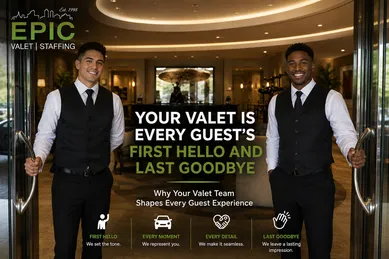
Your valet team is the first person a guest meets when they arrive and the last person they see when they leave. At a hotel, that moment sets the tone for the whole stay and is often the last impression before a review gets written. At a hospital, it may be the first kindness someone receives on one of the hardest days of their year. A valet who makes eye contact, offers a hand with luggage or a wheelchair, and answers questions with patience does as much for your reputation as anyone inside the building.
That’s why the best valet operations hire and train for hospitality first. Great service at the curb looks like:
- A warm, genuine greeting at arrival, not just a ticket handed through a window.
- Help without being asked, whether that’s luggage, an umbrella, a stroller, or a steady arm for a patient stepping out of the car.
- Clear, confident answers about where to go, how retrieval works, and how long it will take.
- Calm under pressure during rushes, so a busy checkout or discharge window never feels chaotic to the person waiting.
- A thoughtful goodbye, with the car ready, the guest acknowledged, and the experience ending on a high note.
At Epic Valet, this is the heart of what we do. As our founder JC Brooks puts it:
“It’s more than taking care of cars, we take care of people.”
We’re an employee-centered company, and that’s deliberate. Team members who are well trained, well supported, and well led are the ones who treat your guests and patients the way you would. When you evaluate any valet provider, ask how they hire, how they train for service (not just driving), and how they support their people. Our guide on what to look for when hiring a valet company covers more questions worth asking. The answers will tell you what your guests will experience.
What a Smooth Transition Looks Like
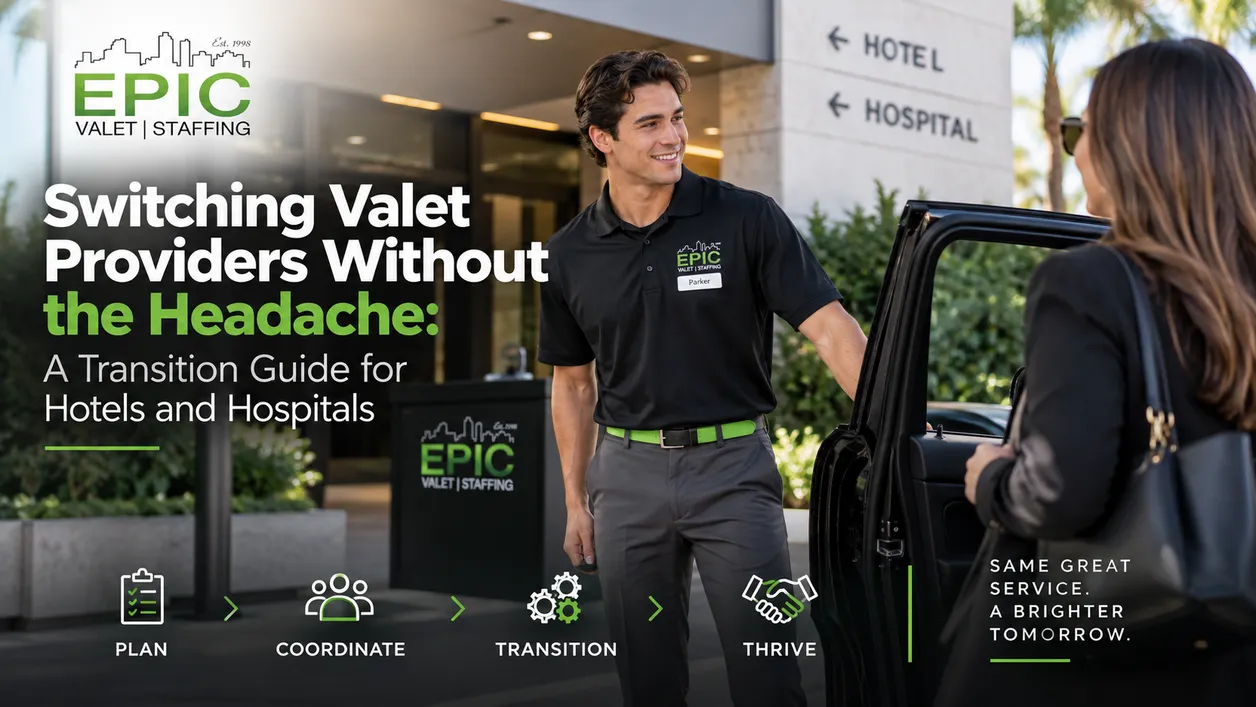
A good valet partner treats the changeover as a project with a plan, not a date on a calendar. A typical transition includes:
- A site survey. Walking the property to understand entrances, staging areas, key control, traffic flow, and peak times.
- A staffing plan built around your real volume. Shifts should be scheduled to your arrival and departure patterns, not a generic template.
- Property-specific training before the first shift. Team members should know your layout, your procedures, and your service standards (how you want guests greeted, helped, and sent off) before they ever take a key.
- Coordination with your team. Front desk, security, and facilities staff should know who to call and how handoffs work from day one.
- Hands-on management at launch. The first days of a new operation should have experienced managers on-site, catching small issues before guests notice them.
Done right, most guests and patients never realize anything changed, except that the service got better.
Training Built for Your Property
Generic valet training produces generic service. At Epic Valet, every team member completes a comprehensive training program that combines video modules, LMS quizzes, and hands-on instruction. For each location, we develop custom training videos and quizzes with input from the client, so our team learns your property: your entrances, your standards, and the way you want guests treated.
That training is backed by a dedicated management team that provides communication and direction on every shift. It’s how we keep service consistent and complaints near zero.
Revenue Collection and Reporting: Where Valet Money Quietly Disappears
For many hotels, valet is a meaningful revenue line. It’s also one of the easiest places for money to slip through the cracks.
The leakage is rarely dramatic. It happens one car at a time: a paper ticket that never gets posted to a room, a multi-night stay charged for one night, a comp with no approval behind it, or a cash transaction with no matching record. By the time a monthly report arrives, it’s nearly impossible to trace what went wrong.
If your valet revenue doesn’t track with your occupancy, or your reports show totals without ticket-level detail, your current system isn’t doing its job.
How Epic Valet Closes the Gaps
Every Epic Valet location runs on a digital ticketing system, so each vehicle has a complete record from arrival to departure. Nothing depends on a paper stub or someone’s memory at the end of a shift.
Our clients receive reports multiple times a day, including a report timed for the night auditor. That means every valet charge is in front of your team before the day closes, so rooms don’t go uncharged and errors are caught the same day instead of weeks later. At properties where the system supports it, charges post to the guest folio automatically, removing manual entry entirely.
For Hospitals and Medical Centers
Many healthcare facilities offer free or validated valet, so the concern is less about lost revenue and more about accurate numbers. Precise, frequent volume reporting helps facilities teams budget, staff for peak hours, and verify exactly what they’re being billed for.
What to Require From Any Valet Provider
Whether you’re evaluating Epic Valet or reviewing your current vendor, ask for:
- Digital, ticket-level records for every vehicle
- Reporting at least daily, timed to your night audit
- A documented approval process for comps and validations
- Clear cash handling procedures
- The right to audit valet revenue at any time
If your current provider can’t meet that standard, it’s worth a conversation.
Hotels and Hospitals Have Different Needs
The fundamentals of a good transition are the same everywhere, but the details aren’t.
For hotels and resorts, the priorities are handling overnight vehicle storage securely, keeping pace with check-in and checkout waves, and making sure every stay is charged correctly. Valet is the first and last impression of the stay, and it should feel like part of your brand, not a separate vendor. (See why professional valet matters for hotels.) Learn more about our hotel and resort valet services.
For hospitals and medical centers, the priorities are patience and care. Patients may be arriving in pain, anxious, or with limited mobility. Valet teams need to be comfortable assisting with wheelchairs and mobility aids, managing multiple entrances such as emergency and outpatient drop-offs, and treating every interaction with discretion. Learn more about our healthcare valet services and how valet improves the patient experience.
Before You Give Notice: Review Your Current Agreement
Before starting a transition, pull your current valet contract and check a few things:
- Notice and termination terms. How much notice is required, and are there penalties for ending early?
- Insurance requirements. Confirm what coverage your current vendor carries and what you’ll require from the next one.
- Claims handling. Understand how open damage claims will be resolved after the changeover.
- Equipment and systems. Know what belongs to you, such as key boxes, podiums, and signage, and what leaves with the vendor.
- Revenue terms. Make sure final revenue and reports are settled cleanly.
Having these answers in hand makes the transition timeline much easier to plan.
Results Clients Notice
“Epic made huge positive changes in our valet operations that virtually eliminated our customer complaints.”
— Pat Williams, WM Phoenix Open
Since 1998, Epic Valet has built its reputation on thorough training, true professionalism, and genuine care for every guest interaction. Today we serve hotels, hospitals, restaurants, and venues across Arizona, Utah, and Colorado.
Ready to Talk About a Better Valet Operation?
Your guests and patients deserve to be taken care of from the moment they pull up to the moment they drive away, and your property deserves a valet partner that treats every arrival as part of your brand. If your current valet service isn’t meeting that standard, we’d be glad to walk through your property and show you what a transition to Epic Valet would look like.
Contact us, request a quote, or call 480-874-1234 to get started.